Recommended setup: Create “No Timeline During Work,” add x.com and twitter.com, and test it unlocked before scheduling focus hours. Leave t.co off the blocklist: it is a redirect service whose links can lead to X or to unrelated work sites.
The exact profile recipe
This reversible recipe blocks the whole X website during a planned focus window. It uses both the current x.com domain and the legacy twitter.com domain, because old bookmarks and shared links still use the older name. It does not claim to hide only the “For You” timeline.
| Setting | Value | Reason |
|---|---|---|
| Profile | No Timeline During Work | Names the habit and the access boundary. |
| Website rules | x.com, twitter.com | Covers the current parent domain and legacy links. |
| Schedule | Monday–Friday, 09:00–17:00 | An example work window; change it to match your real week. |
| Lock | Off during testing | Lets you repair an incomplete rule without trapping yourself. |
1. Create a dedicated X and Twitter profile
Open DeepZone from the Mac menu bar, add a profile, and name it “No Timeline During Work.” Pause it while configuring. In Blocklist → Sites, add x.com and twitter.com as separate entries.
These are domains. In help.x.com, help is a subdomain of x.com; in x.com, .com is the top-level domain (TLD). A route such as x.com/home adds a path. This recipe blocks the parent domains rather than trying to filter individual timeline paths. Do not enter t.co: X’s official help says that service redirects links to their destinations, which may be X or an unrelated site you need for work.
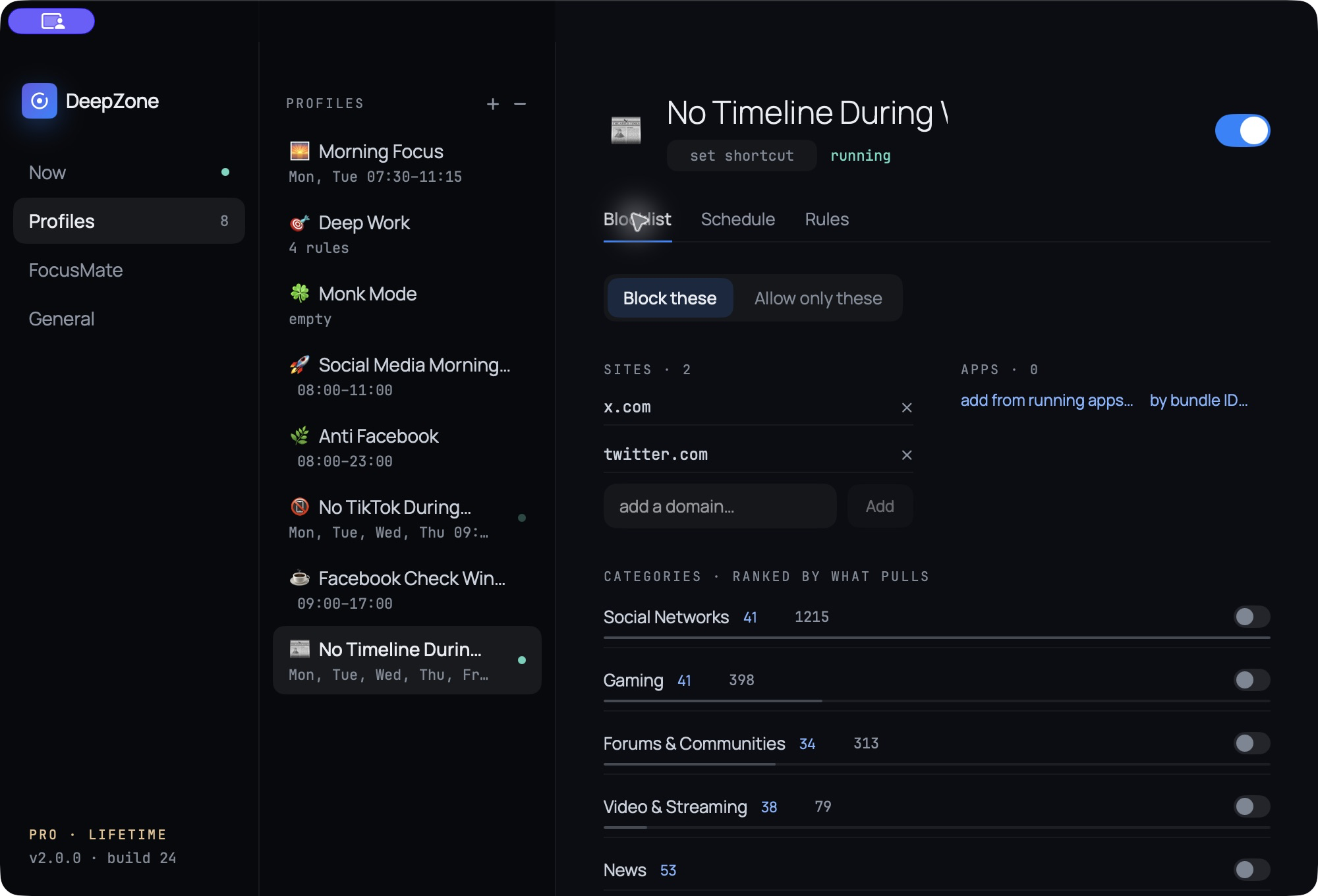
Whole-site tradeoff: timelines, posts, search, messages and publishing tools on x.com stop together during the focus window. If X is part of your job, schedule a separate support or publishing window; this recipe does not promise same-domain exceptions.
2. Test the blocked route and a required route
Start the profile while it is still unlocked. During an unlocked October 9 session, fresh requests to https://x.com/ and https://twitter.com/ were refused while the profile was running; https://deepzone.app/ returned HTTP 200 in the same session. The raw route log is private QA evidence.
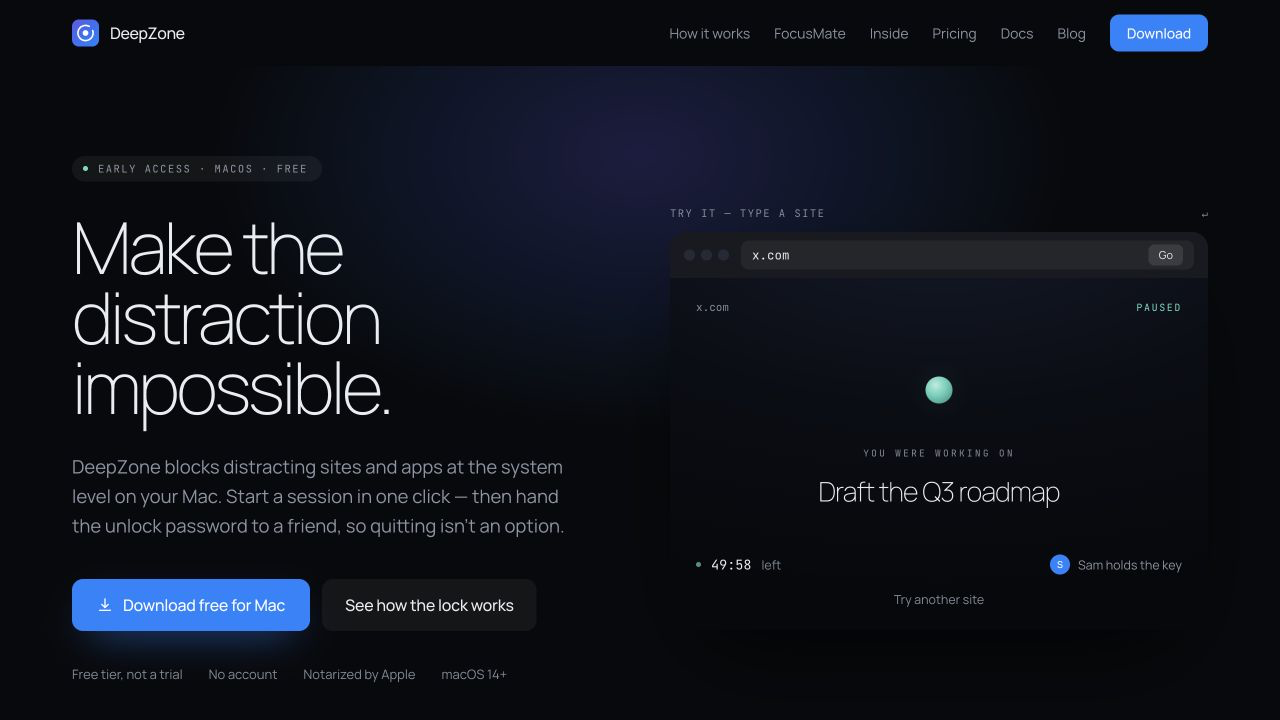
x.com, captured from deepzone.app. It illustrates the product UI and is separate from the live route-test log.Then verify the route you must keep. The DeepZone site remained reachable while X and legacy Twitter were blocked.
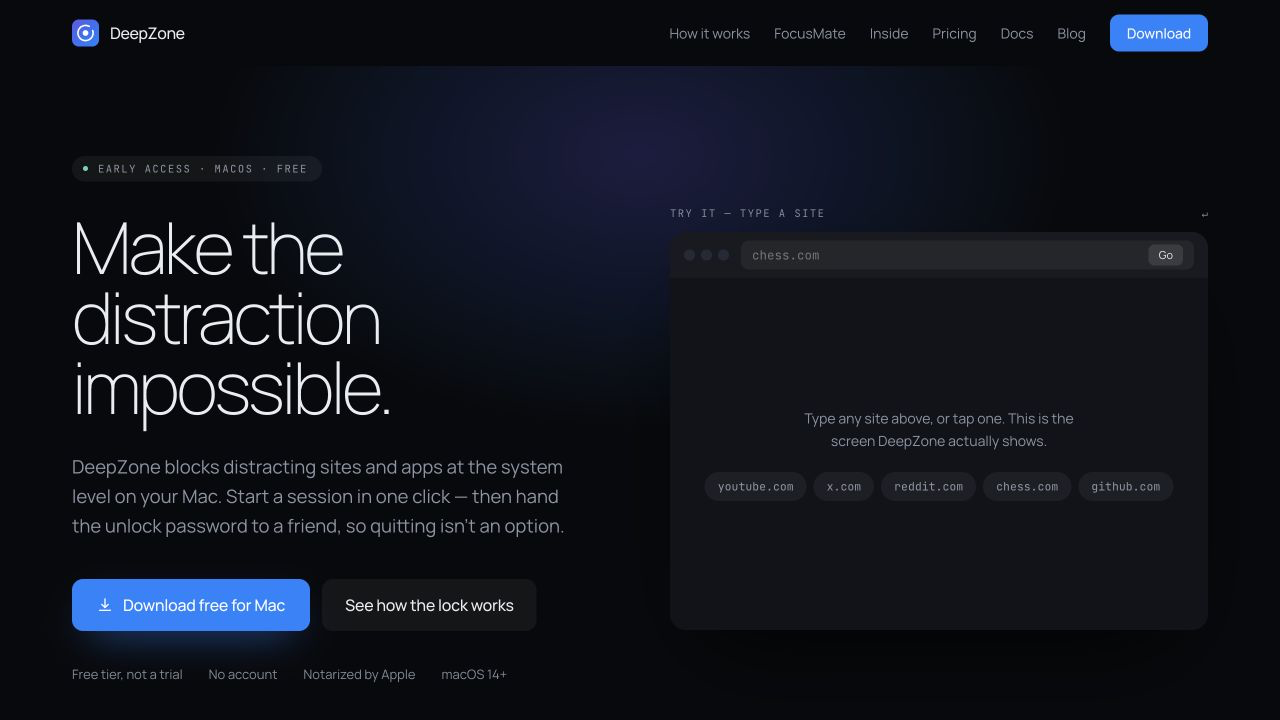
deepzone.app remained reachable during the same active test session.3. Add the work or study schedule
After both website rules work, add recurring hours. A typical work profile might run Monday–Friday from 09:00 to 17:00. For the boundary check shown here, the isolated profile used Friday 14:20–14:30 so the end could be observed without leaving a long-running block.
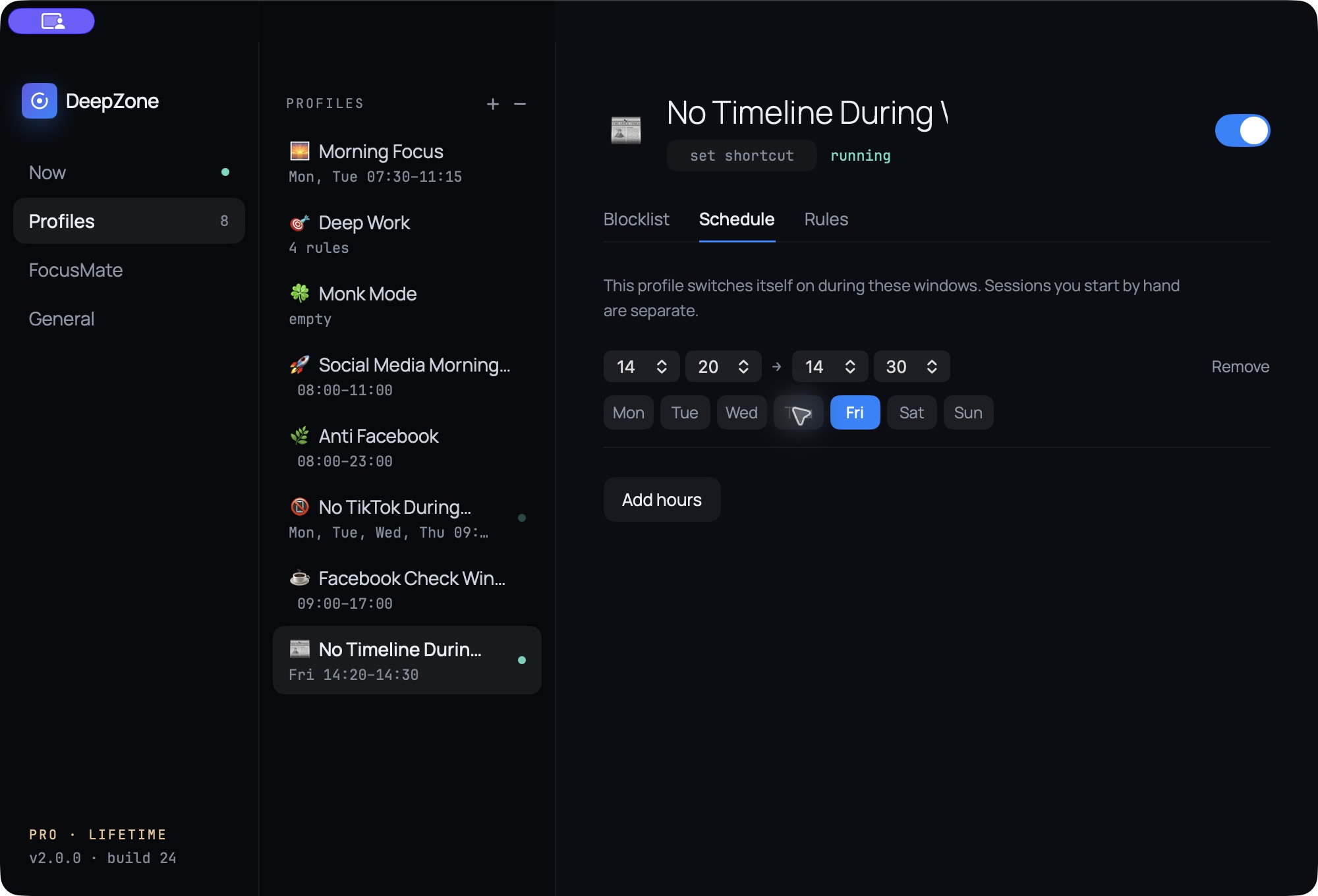
Keep Lock Mode off until the profile starts, blocks both domains, preserves needed access and stops at the expected time on your Mac.
4. Understand domains and redirects
A two-domain recipe is simple, but links can still pass through other hosts. Use this checklist before relying on the schedule:
| Route | How to test | What to record |
|---|---|---|
x.com | Open the home route in a fresh tab. | Blocked during the active test. |
twitter.com | Open a legacy bookmark or direct root URL. | Blocked before any useful redirect could load. |
t.co | Inspect the destination before deciding what to block. | Left unblocked. t.co/lr reached an X-owned host that the parent rule then blocked; a separate t.co link reached an unrelated YouTube work destination with HTTP 200. |
| Needed work route | Open a site you need during focus time. | deepzone.app loaded during the active test. |
| Scheduled end | Repeat both domain checks after the profile pauses. | Both domains returned HTTP 200 immediately after the tested 14:30 boundary. |
If an X route still opens, record its exact hostname before changing the list. Do not add media, image or shortener hosts speculatively: doing so can break embeds and unrelated links without making the core recipe more reliable.
What this test proves—and what it does not
Established on October 9, 2026: the isolated profile in DeepZone 2.0.0 build 24 contained only x.com and twitter.com; both were blocked during an active unlocked session while deepzone.app remained available. A t.co redirect to YouTube also completed with HTTP 200. In the separate boundary test, both blocked domains returned HTTP 200 after the schedule ended.
What this does not establish: it does not selectively remove the “For You” feed, one external t.co sample does not prove every historical destination, and it does not preserve X publishing or support tools that share the blocked parent domain.
Add strictness only after the recipe survives
For the first run, keep the profile unlocked and short. Once the blocked and allowed routes behave correctly, let the schedule run for several real sessions. If you repeatedly pause it early, DeepZone’s official product page describes Lock Mode as a Pro control that freezes settings, block lists, and quitting for the chosen duration. A stronger lock cannot repair a missing domain, so it belongs at the end of the setup—not the beginning.
Sources and test record
- DeepZone official product page — website blocking, profiles, schedules and browser coverage; checked October 9, 2026.
- DeepZone Privacy Policy — local handling of profiles, schedules and blocked lists; checked October 9, 2026.
- X Help: the t.co link service — official explanation that X rewrites shared links through
t.coand sends holders to the destination; checked October 9, 2026. - X Help: posting links — official confirmation that posted URLs use the
t.coservice; checked October 9, 2026.
The private capture manifest and route log are stored outside the public article folder. The profile and schedule images are direct current-build app captures. The interruption-screen image comes from DeepZone’s official live product demo and is labeled as a product-UI reference rather than a fresh route-test screenshot.